Now Available – B Corporations in Arizona

Welcome to Arizona! by Fred Miller from Flickr (Creative Commons License)

Welcome to Arizona! by Fred Miller from Flickr (Creative Commons License)

One of the awesome developments in the Arizona business community for 2015 is that businesses are allowed to form benefit corporations (B corporations) in this state. These are for-profit corporations that have other motives for being in business besides maximizing profits, and their shareholders are aware and accept that the company has dual motives. This motive must be to at least provide a “general public benefit,” meaning the business has a “material positive impact on society and the environment, taken as a whole, as assessed against a third-party standard, from the business and operations of a benefit corporation.” This option became available in Arizona at the beginning of the year.

Given that this is a new type of business entity in this state, I looked to the Arizona Corporation Commission (ACC) to get answers to my questions about B corporations.

What information does a company have to provide to the ACC in the Articles of Incorporation?
To create a B corporation, the incorporators must fill out the same Articles of Incorporation as other corporations in Arizona and pay a $60 filing fee ($95 for expedited processing). Every corporation is required to file an annual report with the ACC. B corporations must file an annual report and an annual benefit report where the company describes what general public benefit it provided. Each report has a separate filing fee.

Can an existing Arizona corporation be converted to a B Corporation? If so, how? Please include information about the associated fee(s).
Yes. An existing Arizona corporation can be converted to a B corporation by filing an Articles of Amendment with the ACC and paying a $25 filing fee ($60 for expedited processing). An Arizona LLC can also be converted into a B corporation under the Arizona Entity Restructuring Act.

Is a B corporation taxed like a C corporation? If so, can a company be a B corporation and file as an S corporation with the IRS?
Traditional corporations are C corporations, and they have double taxation where the corporation pays taxes on its income and the shareholders pay taxes. If the company qualifies, it may elect to be taxed as an S corporation where there is pass-through taxation so only the shareholders pay taxes on the income. Based on my research, a B corporation is taxed as a C corporation, but it has the option, if it qualifies, to be taxed as an S corporation.

I tell all clients to talk to their accountant before starting their business to determine which type of business entity is right for them and to make sure they understand the tax implications. And yes, every business needs an accountant.

Where can people go for more information about B corporations in Arizona?
The ACC created a legislative update that is filled with information and links about B corporations in Arizona. This is a great resource if you’re interested in starting a B corporation or converting your business to a B corporation. If you still have questions after reading this, contact the ACC or a business attorney in your community.

If you’re interested in B corporations but are unsure you want to create or convert your business to one at this time, you can look into being “B Corp. Certified” by B Lab.

If you want to chat with me about this topic, feel free to connect with me on TwitterFacebookYouTubeLinkedIn, or you can email me.

Please visit my homepage for more information about Carter Law Firm.

Be Wary of Downloading Contract Templates

Copy Taste by Maik Meid from Flickr (Creative Commons License)

Copy Taste by Maik Meid from Flickr (Creative Commons License)

One of the questions I frequently get at my speaking gigs is where can people go to find good contract templates online. This question makes me simultaneously happy and nervous. On one hand, I’m happy that the person is asking about their contract needs; however, I’m nervous that they think there might be an acceptable resource online that could replace proper legal advice.

I usually tell these people that contract templates from the internet are a good place to start when doing research on a type of contract and the types of provisions they should include in their agreement. It should be the beginning of their search, not the end. When you look at a contract template online you can never know for sure who wrote it, where it came from, or whether it would be suitable for your needs. There have been many times when I’ve seen someone using a contract for their business that had provisions that made no sense – like a 2-person business that had an operating agreement that required a 2/3 vote to make changes and an Arizona-based business that was using a contract that said the agreement was governed by New Jersey law.

Instead of looking on the internet for a template, you might be better off asking your colleagues in your industry if they would be willing to share their contract templates, depending on where they got them. You are more likely to find provisions that are applicable to your business and the practices of your industry.

Regardless of where you get your templates, it’s always a good idea to have a business lawyer review them before you use them for your company. Otherwise you may find yourself using a contract that is bad for your business, and as long as the provisions of the contract are legal, you could be stuck with it. It may not be as expensive as you think to have a lawyer review your contract in advance. I’ve always said it’s cheaper to hire a lawyer in the beginning to prevent problems than to have to hire one after the fact the clean up the mess.

If you don’t already have a contract template you’re considering using, talk with your lawyer about whether it would be more cost effective for you to find or create your own contract draft for them to review or simply hire a lawyer to create your contract from scratch.

And be equally leery of contract templates created and sold by lawyers. Some of these are good and some of these are crap. I saw an operating agreement this year that was created by a law firm that sells start-up packages for businesses. My client asked me to review the contract to help him resolve a problem with one of the owners. This contract was dozens of pages long, was filled with excessive legalese, and did not address all of my client’s needs; hence, he needed a hire me to help him fix his problem.

Best of luck to everyone whose plans for 2015 include starting a new business. Creating contracts to suit the needs of your business should be one of the many things on your to-do list. If you want to chat with me about your business plans for 2015, feel free to connect with me on TwitterFacebookYouTubeLinkedIn, or you can email me.

Please visit my homepage for more information about Carter Law Firm.

What is a Statutory Agent?

FW Pomeroy's statue of Justice atop the Old Bailey by Ben Sutherland from Flickr (Creative Commons License)

FW Pomeroy’s statue of Justice atop the Old Bailey by Ben Sutherland from Flickr (Creative Commons License)

If your plans for 2015 include starting a business, you need to understand what a statutory agent is.

Starting a business usually begins with filing paperwork with your state’s corporation commission to create an LLC or a corporation and paying a fee. (Talk with your accountant to determine which entity is right for you. And yes, every business owner needs an accountant.)

Filling out the paperwork is a fairly straight forward process, and part of that will be designating a statutory agent for the business. A business can be sued just like a person. In the event that the business gets sued, the process server will need to know how to serve the business. They can’t serve a building – they need to serve a person. Your statutory agent is the person who will accept service (notice that you’re being sued) on behalf of the company. You have to provide a name and a street address.

As long as you live in Arizona, you can be your own statutory agent. Most business owners I work with choose this option. The only thing I remind them about is this information is publicly available on the corporation commission website, so if you’re running a home-based business, you’ll be using your home address. For people who live out of state or who don’t want to be their own statutory agent, there are companies who will provide this service for you. You pay a monthly or annual fee and they agree to accept service on your behalf. Many of these companies will also provide your business address as well.

In the event you are in a position where you want to sue a company, you’ll have to look up that company’s statutory agent to determine where to have them served. It’s an important part of beginning a lawsuit.

A gentleman called me a few weeks ago asking me to explain what a statutory agent is. The phrase “statutory agent” can sound scary to some, but the scope of the position’s responsibility is very narrow.

If you want to chat with me about your business plans for 2015, feel free to connect with me on TwitterFacebookYouTubeLinkedIn, or you can email me.

Please visit my homepage for more information about Carter Law Firm.

End of the Year To-Do List for Entrepreneurs

5/4/2010: To-Do List by john.schultz (Creative Commons License)

5/4/2010: To-Do List by john.schultz (Creative Commons License)

We’ve made it to December 2014! It’s hard to believe another year has flown by. I don’t know aobut your industry but most people stop calling their lawyers around the 15th or 20th of the month. (Exception: DUI attorneys.) That will give me almost two weeks to review and tie up loose ends from 2014 and get ready to hit the ground running in 2015. There are certain things I do as an entrepreneur during this time and I think they’re things all entrepreneurs should do.

1.  See your Accountant
I’ve said it before and I’ll say it again: a good business accountant is worth their weight in gold. I see my accountant twice a year – when I’m getting ready to do my taxes in February or March and every December. Every December he looks at my books to give me an estimate regarding my taxes for the next year and tell me if I should do a spend down before the year ends. We also talk about my plans for the next year and what financial implications might be on the horizon.

If your accountant advises you to do a spend down, buy quality things for your business – like new software or equipment or pre-pay for legal projects you want your attorney to tackle. Don’t buy a ton of pens and sticky notes that will take you a decade to use.

2.  Fund your Retirement Account
If you’re an entrepreneur, there’s a good chance you don’t have a 401(k) through your company. When you are your own boss, it’s your responsibility to prepare for your financial future, including getting a retirement account. If you don’t have one yet, start one. If you have one, give the maximum contribution if you can. The more you can put away when you’re younger, the faster it will grow.

3.  Review your Progress from 2014
I hope you had a list of goals for this year. Now is a great time to get that out and review all that you’ve done this year. Celebrate your victories and successes, and when you came up short, ask yourself what happened. Was it an unobtainable goal? Was there a shift in the company that made it a lower priority? Did you forget that it was your goal? Take some time to reflect on how you personally and how the business has changed in the last 12 months.

4.  Write Down your Goals for 2015
Think about the year ahead. What do you want to be able to say you did a year from now? Think about what you want to accomplish in the next 12 months and write down your goals. Try to make your goals measurable, tangible, and specific so it’s easier to determine if you’ve achieved them. Really take some time to think about what you want to do in 2015 and start laying the foundation to make it happen.

I hope you’ve have a productive year and that you’re excited for what’s to come. I know I am – there are many projects in the works for 2015. If you want to chat with me about this topic, feel free to connect with me on TwitterFacebookYouTubeLinkedIn, or you can email me.

Please visit my homepage for more information about Carter Law Firm.

Truth in Advertising – Deceptive Word Choices can be Costly

My Vibram Fivefingers by Lavender Dreamer from Flickr (Creative Commons License)

My Vibram Fivefingers by Lavender Dreamer from Flickr (Creative Commons License)

I’m sure you’ve heard about the class action lawsuit that claimed that Vibram misrepresented how its FiveFingers shoes benefited consumers’ health.  In the settlement, Vibram offered to provide a refund to any purchaser who requests it. Vibram created a site about the settlement that will provide information, including how to file a claim if you qualify.

Unfortunately, cases like this are not uncommon. I saw a similar article in the Wall Street Journal last week where Proctor & Gamble (makers of Crest) sued Hello Products for false advertising when Hello put a claim on its toothpaste that said the product was “99% Natural.” Hello was forced to remove ~100,000 tubes of toothpaste from store shelves, change the claim “99% Natural” to “Naturally Friendly,” and pay “six figures” for legal fees related to this case.

So how do you avoid these problems? It’s pretty easy – just be truthful.

Federal rules about truth in advertising require that all your advertisements be “truthful and non-deceptive.” If you make any claims, you must be able to back them up with evidence. If you have endorsements, they must be truthful and accurate, and you must disclose when a person is compensated for giving their opinion. (This includes getting free products.)

If you violate these rules, you might receive a cease and desist letter from your competition or the Federal Trade Commission which is tasked with protecting consumers. You could also be fined by the FTC, be sued for unfair competition and/or false advertising by another company, and/or face a class action lawsuit from consumers who claim that they were deceived into buying your product.

When you are working on your marketing campaigns, be careful that your marketing team doesn’t create content that crosses the line from mere puffery into false advertising. If you haven’t done so yet, review the FTC’s Truth in Advertising website.  They have useful information about required disclosures, using endorsements and testimonials, and making health or “green” claims about your products. If you have legal counsel, consider inviting them to your marketing meetings or at least have them review your materials to make sure that your team doesn’t inadvertently cross the line into false advertising.

If you want to talk more about truth in advertising, you can connected with me on TwitterFacebookYouTubeLinkedIn, or you can email me. There’s also a chapter dedicated to endorsements and blogging in my book, The Legal Side of Blogging: How Not to get Sued, Fired, Arrested, or Killed. You can also subscribe to the Carter Law Firm newsletter.
Please visit my homepage for more information about Carter Law Firm.

What was up with General Mills’ Legal Terms?

General Mills Kids Breakfast Cereals by Mike Mozart from Flickr (Creative Commons License)

General Mills Kids Breakfast Cereals by Mike Mozart from Flickr (Creative Commons License)

I got lots of messages last week when it came out that General Mills’ legal terms said that if you downloaded their coupons, connected with them on social media, entered a contest, or purchased any of their products that you agreed to resolve all disputes with the company through binding arbitration or informal negotiation via email.

And everybody lost their minds.

I can understand requiring arbitration for disputes related to contests. I write terms of service for websites all the time and I also include a dispute resolution where my client specifies where, how, and using which state’s law problems will be resolved. I would never tell a client to write their terms in a way that dictates how they’re going to resolve problems that are not related to a website.

I think it’s ridiculous that they’d even try to tell consumers that making a purchase forces them to resolve disputes in arbitration unless those provisions are available on the packaging and in print that might make a consumer take notice. I’ve never thought to examine a cereal box for contract terms.

Thankfully General Mills saw the light and reversed its decision and voided the offensive terms this past Saturday. In a blog post, General Mills spokesperson Kirstie Foster wrote, “No one is precluded from suing us by purchasing our products at a store, and no one is precluded from suing us when they ‘like’ one of our Facebook pages.”

General Mills still supports arbitration for resolving disputes and I understand why. It can be a faster and more cost-effective way to resolve problems. However, some disputes are better left to litigation where there is the option to pursue a class-action lawsuit when the situation warrants it.

We agree to contract terms all the time. Every time we click the “I agree” button for an online service or to create an account on a social media platform, we are agreeing to the terms of the contract (even if we don’t read the terms). The next time you go to a concert or a professional sporting event, flip over your ticket and read the fine print on the back. That’s a contract. I have no problem with these contracts as long as they make sense for the situation and don’t overreach into scenarios where it would be unreasonable for the terms to extend.

My Neighborhood Whataburger

My Neighborhood Whataburger

For example, I recently heard that there was a sign at a Whataburger restaurant that put consumers on notice that by eating in the restaurant, they agreed to resolve all disputes related to their dining experience via arbitration. I tried to confirm this but I didn’t see such a sign in my neighborhood Whataburger. I visited their website and didn’t see such a provision; however, I was perturbed to see terms and conditions that said:

By giving us permission to use your post or tweet, you agree that we may, at our discretion, use your real or social media user name and the content of your post or tweet (including all accompanying images) on our website to promote our company, products and services for such time period as we wish. You give us the right to edit your post or tweet for brevity, clarity and the like and to modify any image in any manner we deem necessary to use it on our website. You will not have the advance right to review or approve what we post on our website….You will not receive any compensation for granting us the above rights. We agree that you may withdraw the permission you have given us at any time by sending us an email at customerrelations@wbhq.com.

Whataburger’s Facebook page says they can use anything you post on their page but I didn’t see any similar verbiage on their Twitter profile. I think they’re trying to set themselves up so they can use anything you post about the company on social media, including editing it which I’m not too keen about the verbiage they used.

This is a topic that is worth watching to see what becomes the norm in social media marketing. I f you want to talk more about terms of service or social media law, connect with me on TwitterFacebookYouTubeLinkedIn, or you can email me. Please subscribe to the Carter Law Firm newsletter and visit my homepage for more information about Carter Law Firm.

Arizona Fantasy Gaming Bill Fails

Fantasy Football League 1 Draft by Jay Thompson from Flickr

Fantasy Football League 1 Draft by Jay Thompson from Flickr

Arizona lawmakers have, once again, shown how lame they are. Earlier this year they approved the anti-gay SB 1062 which was thankfully vetoed by soon-to-be-former Governor Brewer. This time they killed SB 1468, which would have legalized fantasy sports.

Arizona is one of a handful of states where fantasy sports are illegal. Sometimes this means that Arizonans can’t participate in fantasy sports if they admit their true location or they’re allowed to play but they can’t accept prizes if they win – even if there’s no fee to play or the prize is as simple as a t-shirt.

Here’s what’s super lame – Under federal law, fantasy sports are legal!  Under the Unlawful Internet Gambling and Enforcement Act of 2006 (UIGEA) fantasy sports aren’t gambling because each participant’s team is made up of players from multiple teams and the results are based on the participant’s knowledge and skill. I can speak from my limited experience playing in the Deadliest Catch fantasy game that it definitely takes knowledge and skills. Unfortunately fantasy gaming is regulated at the state level so each state has the option to say that fantasy games are illegal.

Apparently SB 1468 was killed due to the influence of the Arizona Indian Gaming Association. They were afraid that legalizing fantasy games would negatively impact the tribal gaming compacts. I can understand that the tribal casinos want to have a monopoly on gambling in the state but I don’t see how fantasy sports would hurt them. I doubt that people will give up black jack and slot machines for a fantasy league. I think they’re afraid that people would start fantasy gaming businesses that could create competition for the casinos but I have serious doubts that people who love to hang out in casinos will give that up for fantasy gaming.

Technically fantasy gaming is a Class 5 felony in Arizona, and anyone convicted could face at least 6 months in jail and up to a $150,000 fine. As far as I know no one has been charged or convicted of violating this law and law enforcement isn’t concerned with pursuing these “criminals.” So it’s a law on paper, but in reality it’s just lame. Hopefully lawmakers will legalize fantasy games next session.

If you want to chat more about this issue, connect with me on TwitterFacebookYouTubeLinkedIn, or you can email me. You can also subscribe to the Carter Law Firm newsletter.
Please visit my homepage for more information about Carter Law Firm.

How to Register a Trademark with the USPTO

USPTO Seal by cytech from Flickr (Creative Commons License)

USPTO Seal by cytech from Flickr (Creative Commons License)

I’ve had several people ask me what is involved in registering a trademark with the U.S. Patent and Trademark Office (USPTO). Your trademarks include the names, logos, tag lines, and anything else you put on your products and services to inform customers about the source and quality of what they’re buying.

Once you have a trademark registered with the USPTO, you have the exclusive right to use your trademark on your goods or services anywhere in the U.S.  If anyone tries to start similar business or sell a similar product with trademark that is too similar to yours, you can make them change it. The only companies that can have the same trademark as you are companies who were using the same trademark before you registered yours with the USPTO (i.e., the Burger King situation) or companies that use a similar trademark but on a product that is so different from yours that no one would think that they are owned by the same company (i.e., Delta Faucets, Delta Dental, and Delta Airlines).

Here is the process that I go through to register a client’s trademark with the USPTO:

1. Clarify what the trademark is and what products or services it’s being used on. You can only claim rights to a trademark that you’re using in commerce or expect to use within six months.

2. Determine if the desired trademark is trademarkable – not every trademark is. Your trademark can’t be the product itself.

3. Check the USPTO database to make sure no one else has registered the same trademark on a similar product as my client’s.

4. Evaluate if others are using the same trademark without registering it with the USPTO. Once your have a registered trademark, these companies can keep using it in their established geographic market, but they can’t expand without rebranding.

5. Complete the USPTO trademark application which includes determining the best description of the product and which class(es) of products we’ll be applying for. The USPTO charges a fee for each class of products you register the mark for.

6. Submit the application to the USPTO with the filing fee.

7. Wait three or four months for the USPTO to get around to reviewing your application. Yes, their backlog is that big. Once I submit an application, I typically check on it at the beginning of each month to see if it’s been assigned to a reviewing attorney at the USPTO.

8. Respond to any Office Actions if we receive any from the USPTO. An Office Action is a communication from the reviewing attorney that says that there’s a problem with the application. They may request clarification, a disclaimer, or claim that the desired mark can’t be registered. Depending on what the USPTO and my client wants will determine how I respond and how much work will be required.

9. Once the USPTO approves the mark, they will publish it on its official gazette. This puts everyone on notice that your mark is about to be approved. If no one objects within thirty days, your trademark will be registered.

You should expect the entire registration process to take at least eight months, but it could be longer. Once you have a registered trademark, you can use the ® next to it. You will continue to have your trademark rights as long as you’re using it in commerce. The USPTO requires that you send in update affidavits periodically that verifies that you’re using the trademark. If you don’t use your trademark for three consecutive years, it will be considered “abandoned” and anyone can use it.

If you’re looking for more information about what a trademark is and the benefits of registering it with the USPTO, I made a video about it.

If you want to chat more about trademark registration, you can connect with me on TwitterFacebookYouTubeLinkedIn, or you can email me. You can also subscribe to the Carter Law Firm newsletter.
Please visit my homepage for more information about Carter Law Firm.

How To Change Your Business Address with the Arizona Corporation Commission

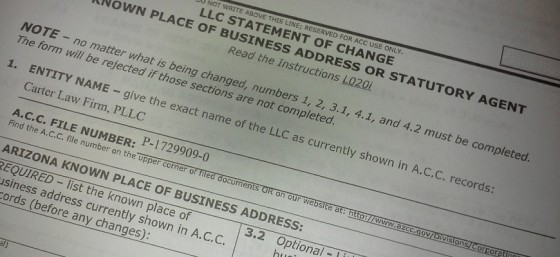
A.C.C. Statement of Change Paperwork for Carter Law Firm

A.C.C. Statement of Change Paperwork for Carter Law Firm

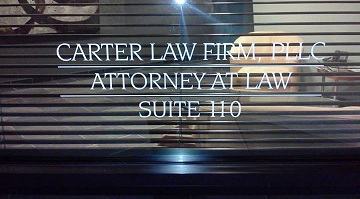
One of the exciting things that’s happened at Carter Law Firm in the last few months is we’ve moved from being a virtual law practice to having a brick-and-mortar office. It’s been wonderful settling in to our new digs.

My New Office!

It’s Official!

As you all know, one of the things you have to do when you move is update your address. The firm’s mail service is paid up until March 2014 so we have plenty of time to update our information with all of our vendors, but then I started thinking about what we’d have to do with State and these were the type of questions that went through my head:

  • Ugh – How much of a pain in the ass is it going to be to update our information at the Corporation Commission?
  • Is it going to be expensive?
  • Do we have to publish?

I jumped on the Corporation Commission’s forms page for LLCs and started digging around. I was pleasantly surprised to learn that updating the business and statutory agent’s address would be relatively simple to do. According to them, all it takes is a Statement of Change and a $5.00 fee – and no publication required. The paperwork was straightforward – old address, new address, and a signature. I didn’t change my statutory agent, just their address, so I didn’t have to complete the statutory agent acceptance form. I slapped on their cover sheet, wrote a check, made a copy of the paperwork for my records, and popped it into the mail.

Rosie Watching the Office Through her Baby Gate

Rosie Watching the Office Through her Baby Gate

I could have paid an extra $35.00 to expedite it, but it wasn’t necessary so I didn’t. It will take them up to a month to update my file at the Corporation Commission, but I’ve had no trouble updating my address with anyone. I was surprised the bank didn’t ask to see my paperwork; they just took my word for it when I showed them my driver’s license.

Now we’re in the process of getting everything updated – ordering new business cards and checks, updating the website, etc. It feels good to be in a proper office – especially one that lets Rosie come to work with me. She’s still getting used to office life. Watching the world through the office baby gate is less exciting than watching the street through the front door screen, but she loves the attention from my officemates.

You can connected with me on TwitterGoogle+FacebookYouTubeLinkedIn, or you can email me. You can also subscribe to the Carter Law Firm newsletter.
Please visit my homepage for more information about Carter Law Firm.