Simple Contracts with Foamy the Squirrel

Merry Christmas from our Ninja family to yours! by thotfulspot from Flickr

Merry Christmas from our Ninja family to yours! by thotfulspot from Flickr

If you want to create a contract, the minimum you need are three things.

  1. An Offer
  2. Acceptance of the Offer
  3. Consideration

Consideration is a legal term for a “bargained-for exchange,” which is a give-and-take between the parties. And it has to be an exchange that is reasonable. You probably have consideration if you want to sell your car for the Kelley Blue Book value vs selling it for 2 cents.

Check out this Foamy cartoon that appears to create a contract (I heart Foamy):

Here’s the contract offer I heard: Germaine will get Foamy a ninja for Christmas in exchange for shutting up about his disappointment over the ninja gig. And Foamy accepted with the caveats that the Ninja not be American unless it’s Chuck Norris and the penalty for not delivering a ninja would be that thugs get to rape Germaine with her own severed limbs.

Was there consideration? That’s up for debate. Foamy can be pretty awesomely obnoxious. I can see someone offering a higher ticket item to make him shut up. The big problem I see if you can’t make a contract for something that is illegal. Owning a person is illegal which could be one interpretation of the contract’s terms. Foamy’s caveat about the severed limbs obviously doesn’t hold water.

Check how the contract was executed:

It sounds like Germaine was blackmailed into giving Foamy a ninja, which arguably makes this whole exchange invalid since she was afraid for her life and not acting to get the bargained for exchange. Setting that aside, I can see consideration in exchanging a toy for getting someone to shut up. Foamy could argue that both parties knew that he was bargaining for a real, breathing, human ninja, but that would make the contract invalid since owning a person is illegal. In the end, I think Foamy should take his plush ninja and be happy he got a present.

Happy Ninja Christmas Everyone!

You can connect with me via Twitter, Google+, Facebook, and LinkedIn, or you can email me.
Please visit my homepage for more information about Carter Law Firm.

Don’t Post Stupid Stuff Online

Gestures by Tuppus from Flickr

When I was a kid, I had a shirt that said “think” across the chest and “act” across the back. There was tiny print around the bottom hem that had a series of statements that said “think before you ________.” The shirt’s message was, “Think before you act.” If the company made this shirt today, they should modify the design to say, “Think before you post.”

Think B4 U Post by Mister Norris from Flickr

It blows my mind how much stupid shit people post on the internet, and most of the time, you can tell they do it because they think it’s funny in the moment and they don’t think it all the way through. Before you post anything on the internet, regardless of what it is and where you’re putting it, ask yourself 2 questions:

  1. What’s the worst thing that could happen?
  2. How many ways could this blow up in my face?

We all know how fast an internet post can spread like wildfire. Look at this post by a girl who lost her hat that she got from her mother who died of cancer at the Phoenix airport. I’m sure tens of thousands if not hundreds of thousands of people have seen it. I hope she gets it back. This post went viral because her story touched people’s hearts, but other posts go viral because they’re so offensive.

Always beware of the court of public opinion. You can look like a massive ass on the internet without doing anything illegal. If you do that, be ready for your reputation to be tarnished. That offensive post could easily become the number one result when someone Googles your name, which will hurt your professional and personal lives.

And if you make an offer in a post that is believable, don’t be shocked if someone accepts it. If you post on Facebook, “I lost my phone in a cab in NYC. I’ll give $10K to whoever returns it.” You better get your checkbook out when you get it back or you might find yourself in court for breach of contract.

If you post something on the internet and it garners strong negative reactions, there isn’t much you can do if you don’t like it unless they cross the line into the realms of invasion of privacy or defamation. The only thing you can really do at that point is damage control.

Carter Law Firm’s Postcards

If you post something online and regret it after the fact, deleting it may not be enough to save you. Once you put something out there, you can’t control how many times it will be downloaded, shared, re-posted, and re-tweeted. It only takes a few seconds to create a post, but you may be living with the consequences forever.

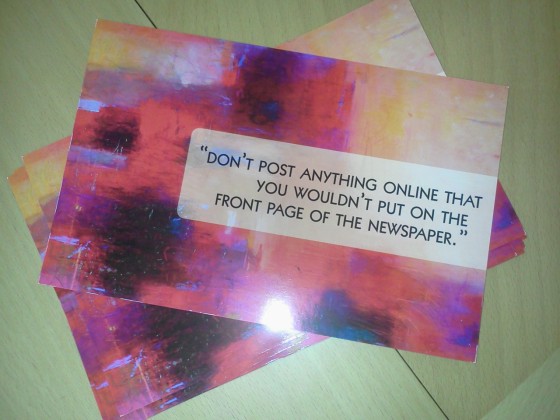
The take away lesson: Think before your post…really think. Don’t put anything online that you wouldn’t put on the front page of the newspaper.

You can connect with me via Twitter, Google+, Facebook, and LinkedIn, or you can email me.
Please visit my homepage for more information about Carter Law Firm.

Can Kasperski keep the FnB Name?

Old Scottsdale Sign by kmaschke from Flickr

Whenever I ask my friends where I should take my quasi-foodie parents when they visit, one of the most common answers I get is FnB. This little restaurant in Scottsdale has won a bunch of awards and gotten a lot of good press since it opened three years ago, including a mention in Food & Wine magazine. The owners Charleen Badman and Pavle Milic recently announced that they’re moving FnB to a new location at the beginning of 2013. Shortly after that, FnB’s soon-to-be former landlord, Peter Kasperski, announced he wanted to keep the name “FnB.”

According to Phoenix New Times, he came up with the name and he likes it, but does that give him ownership rights in the name?

Probably not.

A trademark is the mark used with a product or service that distinguishes it from its competition and informs consumers about the source and quality of what they’re buying. In regards to a restaurant, a mark could be the name, the way the restaurant is decorated (trade dress), logos, and/or slogans. When you have a trademark, you have the exclusive right to use it on your products or services in your established market. If your register your company’s trademark with the U.S. Patent and Trademark Office, you get the exclusive right to use your mark on your products and services nationwide. No one can start a business or create a similar product with a mark that is similar to yours.

Unfortunately, no one has registered “FnB” with the USPTO for use with a restaurant. If Badman and Milic did that, they would have exclusive control over who could open an FnB restaurant anywhere in the U.S.

All is not lost in this story. If Badman and Milic can argue that they are known nationwide, they can make the argument that their established market is the entire country so no one can call their restaurant “FnB” without their consent. There was a case in 1948 about a fancy New York restaurant called “The Stork Club.” They had spent thousands of dollars in nationwide advertising and had been featured in news articles in newspapers throughout the country. They were able to force a small tavern in San Francisco called “Stork Club” to change its name because they made the argument that consumers might think the tavern was affiliated with the restaurant, which could hurt the restaurant’s reputation.

What about Kasperski’s statement that he thought of the name? Trademark rights come from using the mark in commerce. From what I can tell, he’s leased property to a company that used the name. If he didn’t use it himself, he has no trademark rights in the name.

According to Phoenix New Times, Kasperski claims he’s partners with Badman and Milic. I looked up Badman and Milic’s LLC and he’s not listed as an owner, so I’ve seen no evidence that supports that claim.

Kasperski also said Badman and Milic will be successful without the FnB name. Given their success so far, that is probably true; however, that doesn’t change their rights in their business’ name. They were the ones who used the name in their business and build a stellar reputation. Unless there are contracts that explicit give Kasperski rights in the FnB name, I foresee him struggling to make a valid claim in the trademark rights.

The take away lesson: If you want to avoid problems like this, talk with an intellectual property attorney about registering your trademark with the USPTO.

You can connect with me via Twitter, Google+, Facebook, and LinkedIn, or you can email me.
Please visit my homepage for more information about Carter Law Firm.
Carter Law Firm is Starting an Email Newsletter

Letters Never Sent by tnarik from Flickr

This has been on my to-do list for months and I’m finally making it a priority – the firm is starting its newsletter this month.

The goals of my firm’s monthly newsletter are to be short, relevant, and useful. Each edition will address one timely topic and provide updates from the blog and my speaking schedule. It may take me a few months to figure out the best days and times to do my mailings, but you should only get one email a month.

Will my newsletter have a shameless plug for my book? Of course! But I promise it will not be the main content. This newsletter is designed to offer helpful tips and suggestions to my subscribers, not to boost my book sales. If that’s a side effect, it’s just a bonus.

So how can you subscribe? It’s easy – you can subscribe to the newsletter here. Please note you have to add yourself to my mailing list. I will not add you without your explicit request and consent. One of my pet peeves is meeting a new person at a networking event, exchanging business cards, and finding myself added to their newsletter mailing list the next day without consent. I promise not to spam you or to sell my mailing list to third parties.

The first edition of the newsletter is scheduled to be delivered on Wednesday, November 28th. Please subscribe now if you’re interested in receiving it.

You can connect with me via Twitter, Google+, Facebook, and LinkedIn, or you can email me.
Please visit my homepage for more information about Carter Law Firm.

The Oatmeal Sued Again – This Time for Trademark Infringement

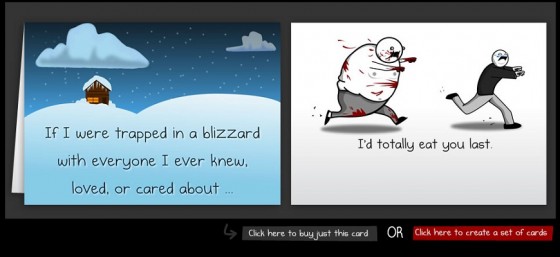
One of the Greeting Cards available on TheOatmeal.com

I suspect he has a harder fight on his hands this time around.

Ars Technica released a story this week that The Oatmeal (aka Matt Inman) is going back to court, courtesy of Oatmeal Studios. Oatmeal Studios is a greeting card company that’s suing the artist for trademark infringement because he’s selling greeting cards on The Oatmeal website.

Matt became more infamous than ever with his legal issues related to FunnyJunk earlier this year. I think that was a pretty easy fight for him to win, but this time he has a more formidable opposition.

According to the USPTO, Oatmeal Studios has been selling greeting cards under this brand since 1978 – that means they’ve been selling cards since before Matt was born. In 2004, the company registered the trademark “Oatmeal Studios” for use on “greeting cards, gift cards, occasion cards, paper party decorations, writing pads, note pads, and memo pads.” That means no one can start using “Oatmeal Studios” as a trademark on these or similar products anywhere in the United States after the mark was registered.

Matt has had his site since at least 2009 according to the WhoIs records. He started drawing comics and now he also sells greetings cards, prints, mugs, t-shirts, stickers and posters on his site.

I suspect Oatmeal Studios thinks “The Oatmeal” is too similar to “Oatmeal Studios” so they want to shut down at least the greeting card arm of his operation. Since they have the federally registered trademark, they might succeed, but I think there’s a strong argument that the marks are different enough and the products are different enough that Matt could be allowed to sell his cards because no consumer would ever confuse the two products.

Let’s take a brief look at the factors the court looks at when deciding the likelihood of confusion.

  1. Strength of the Plaintiff’s Mark: “Oatmeal Studios” for a greeting card company sounds like an arbitrary mark to me, which is a pretty strong mark. This makes it more likely that consumers will be confused about the difference between “Oatmeal Studios” and “The Oatmeal.”
  2. Degree of Similarity between the Marks: The marks are pretty similar. One has an added “the” and the other has “studios.” I think the fact that Matt doesn’t have “studios” or something along those lines as part of his name helps him. “Oatmeal” describes the company on one side but “Oatmeal” describes him as a person on the other.
  3. Proximity of Products: Matt sells his cards on his site. Oatmeal Studio’s cards look like the cards I see in Walgreens and stationary stores. The fact they’re not sold in the same places helps Matt’s case.
  4. Likelihood that the Plaintiff will Bridge the Gap: These companies both sell greeting cards, but I doubt Oatmeal Studios will be selling signed prints, posters, mugs, t-shirts, or stickers anytime soon.
  5. Evidence of Actual Confusion: Has anyone been confused about the differences between Oatmeal Studios and The Oatmeal? I doubt it.
  6. Defendant’s Good Faith in Adopting the Mark: If memory serves, Matt’s alter ego The Oatmeal came from his activities in the gaming world. It had nothing to do with Oatmeal Studios. I suspect when he started his site to share his comics that he wasn’t thinking of creating a line of greeting cards.
  7. Quality of the Defendant’s Product: Go check out Oatmeal Studios’ website. I see no similarities between these cards and The Oatmeal’s greeting cards except that they’re both on paper. I think they’re of equal quality as paper products, but when you look at the quality and characteristics of the artwork, they’re not similar at all.
  8. Sophistication of the Buyer: People who buy The Oatmeal products specifically seek out Matt’s work. They will not even thing for a second that Oatmeal Studios is his work.

I think there’s a good chance that Matt can argue that there is no likelihood of consumer confusion when it comes to these two brands. The names may be similar, but I think the products are different enough that Matt has a good shot at winning. I hope this case also inspires Matt to register his trademark for his products to avoid similar problems in the future.

You can connect with me via Twitter, Google+, Facebook, and LinkedIn, or you can email me.
Please visit my homepage for more information about Carter Law Firm.

On Being an Outspoken Blogger

Call a spade a spade by scarycurlgirl_photos from Flickr

Call a spade a spade by scarycurlgirl_photos from Flickr

I had the pleasure of speaking at TechPhx last weekend. My presentation was entitled The Legal Side of Blogging: 10 Questions to Ask Before you hit “Publish.” We had a great discussion about how to be an outspoken blogger without setting yourself up to get sued for defamation or invasion of privacy. Hat tip to Tyler Hurst who joined us via Ustream from Portland.

I walked away from the discussion with the reminder that big problems can result from little mistakes. Often times saying less is the best course of action. Sometimes it’s best to point out the dots and let your readers connect them. If there’s a news story that’s a hot topic in your community, you may want to write about the topic in general instead of the specifics about the situation. Your readers will know what you’re alluding to without having to explicitly state it.

When you’re a passionate writer, it’s important to state the facts and your feelings as they are without over-embellishing. Don’t manipulate the facts to get the message you want. Take a step back and review your work. Ask yourself what you can think, what you know, and what you can prove. When something is a rumor or an allegation, state that and cite your source when you can. Always be mindful of the fact that you can be sued for defamation if you repeat someone else’s defamatory statement – even if you didn’t know it was false.

One of my favorite ways to state my views without having to be so blunt about it is to quote someone who shares my perspective. I could call someone that I dislike or disapprove of an ass on my blog, but I think it’s more fun and effective to listen when others are talking about the issue and quote one of them when I hear them say “He’s a prick.”

If you want to learn more about your online dos and don’ts, check out my book The Legal Side of Blogging: How Not to get Sued, Fired, Arrested, or Killed.
You can also connect with me via Twitter, Google+, Facebook, and LinkedIn, or you can email me.
Please visit my homepage for more information about Carter Law Firm.
Is It Illegal to Tweet Lies?

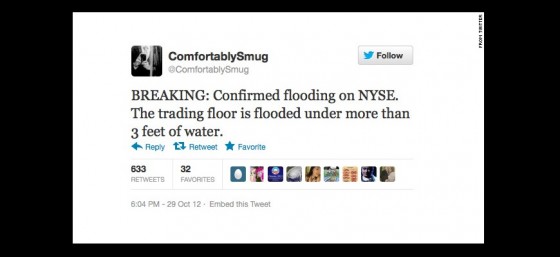
Last week during Hurricane Sandy, many of us turned to Twitter for up-to-the-minute updates about the storm. An anonymous person using the handle @ComfortablySmug made several tweets.

  • BREAKING: Con Edison has begun shutting down all power in Manhattan
  • BREAKING: Governor Cuomo is trapped in Manhattan. Has been taken to a secure shelter
  • BREAKING: Confirmed flooding on NYSE. The trading floor is flooded under more than 3 feet of water.

It was later revealed that the information was false, but not before these tweets were retweeted more than 500 times according to reports.

Buzzfeed’s Jack Stuef investigated the situation and determined that the anonymous tweeter was Shashank Tripathi, a campaign manager for Republican congressional candidate Christopher Wight. Tripathi has since resigned from his position and tweeted an apology for posting inaccurate information. That was his latest tweet from that account.

The New York District Attorney’s Office was asked to pursue criminal charges against Tripathi for his irresponsible tweeting. It will be interesting to see if he’s charged.

What Might He Be Charged With?
In many situations, it’s not illegal to lie unless you’re entering realms like fraud or identity theft. I did some digging in the Arizona criminal code and I could see a prosecutor making an argument that a person who posts inaccurate information during an emergency could be charged with electronic harassment, falsely reporting an emergency or causing public panic, creating a hoax, or possibly something along the lines of disorderly conduct.

Some of these crimes, like electronic harassment, require a victim and Tripathi didn’t appear to have a target. I wonder if issues like this might make the prosecution’s job harder.

What About Tripathi’s Right to be Anonymous?
Yes, the First Amendment protects your right to free speech, including your right to speak anonymously. It does not guarantee your anonymity. If you want to be anonymous, you have the responsibility of not making it easy for others to figure out who you are. Apparently @ComfortablySmug was unmasked because he posted censored pictures of himself and the uncensored version was easily discovered and revealed his identity.

If he committed a crime, his right to be anonymous also went out the window.

What do you think should happen to Shashank Tripathi? Should he be charged with a crime for tweeting lies about Hurricane Sandy? Please share your opinion as a comment below.

If you want to learn more about your online dos and don’ts, check out my book The Legal Side of Blogging: How Not to get Sued, Fired, Arrested, or Killed.
You can also connect with me via Twitter, Google+, Facebook, and LinkedIn, or you can email me.
Please visit my homepage for more information about Carter Law Firm.
Celebrity Trademark Woes

Ivy Leaves by D H Wright from Flickr

Ivy Leaves by D H Wright from Flickr

In the last week there have been a few stories about celebrities running into trouble with prospective trademarks. I thought I’d break down the two major stories I’ve heard.

Blue Ivy
Jay-Z and Beyonce had a daughter earlier this year and named her Blue Ivy Carter. (Why do celebrities give their kids such stupid names?) According to the news report, Jay-Z filed an application to trademark her name within days of her birth. It seems very strange to me that a high priority of a new parent is starting a product line based on their kid’s name.

To have a trademark, you have to select a mark and the product or service you’re going to use it with. A mark can be anything that will differentiate your product or services from the competition – a word, a tag line, a color, a scent, a sound, etc. Its purpose is to inform consumers about the source and the quality of the goods they’re buying. Once you register a mark with the U.S. Patent and Trademark Office, no one can use a similar mark on similar goods and services because it might lead to consumer confusion.

Jay-Z’s trademark plan hit a bit of a snag. When he applied for the trademark, he was likely informed that there are several registered trademarks featuring the phrase “blue ivy.” One is an event and wedding planning service, another is an online furniture retailer, and another is a retail store that sells clothing, jewelry, accessories, and giftware.

Jay-Z and Beyonce could register “Blue Ivy Carter” as a trademark, but not to sell a good or service that was similar to one of the existing registered marks. It appears they’ve registered the mark for skin care products, baby products, ring tones, key rings, and accessories among other things. The list is disgustingly extensive.

The best part of the trademark record is where it says, “The name ‘BLUE IVY CARTER’ identifies a living individual whose consent is of record.” That’s funny.

Khroma
The other trademark story I heard recently involves the Kardashians. Apparently they plan to release a makeup line called Khroma Beauty that is expected to be sold in Sears and CVS Pharmacies. The problem they’re running into is the fact that there’s a salon called Chroma Makeup Studio in Hollywood that sells its own Chroma brand of makeup. I couldn’t discern in a quick search if the studio owner had registered the trademark.

The general rule in trademark is that it’s not enough to have a different spelling of the same word as your competition’s mark. For example, if someone owed an “Alligator Furniture Store” in your city, you probably couldn’t open a competing store called “Allig8tor Furniture.”

Even without registration, the owner of the Chroma mark gets the exclusive rights to use his mark in commerce wherever the market has been established. If nothing else, he might have a valid argument to keep Khroma makeup out of the stores near his studio. He’s asked the Kardashians to change the name of their makeup.

When selecting a potential mark, it’s a good idea to check the U.S. Patent and Trademark Office to see if someone has already registered the mark you want to use on similar goods and services. If they are, you’ll have to pick a new trademark.

It’s also prudent to run a simple Google search to see if someone is using the mark in commerce without registering it. If they are, you’ll have to consider whether it would be better to pick something new or use a similar mark knowing that the other user has the exclusive right to use the mark where they’re established. If you register your similar mark, you can use it everywhere in the country except the areas where your competition established itself prior to your registration.

Feel free to connect with me via Twitter, Google+, Facebook, and LinkedIn, or you can email me.
Please visit my homepage for more information about Carter Law Firm.

Is That Legal – The Zombathalon

Zombathalon - Zombies shamble forth! by Moriartys from Flickr

Zombathalon – Zombies shamble forth! by Moriartys from Flickr

Around Halloween there are a lot of organized zombie walks and zombie races, but we wanted to see what would happen if we created a zombie outbreak in an unexpected location.

Zombathalon - Zombie Outbreak Warning! by Moriartys from Flickr

Zombathalon – Zombie Outbreak Warning! by Moriartys from Flickr

Improv AZ organized a group of 13 zombies that invaded the Arizona Canal, a popular running/walking/biking path in Phoenix over the weekend. For about 30 minutes we stumbled and groaned up and down a section of the canal while covered in fake blood, ripped clothes, and with pasty white makeup covering our skin. We warned people that they were coming upon a gaggle of zombies by posting yellow signs covered in fake blood that said, “Warning: Zombie Outbreak.”

We had an awesome time entertaining, surprising, and scaring our unsuspecting audience, but was it legal?

Did We Commit Trespassing?
No. It was a public path. Everyone’s welcome to use it.

Did We Commit Assault?
No. Assault requires intentionally, knowingly, or recklessly causing a physical injury or putting someone in reasonable fear of physical injury. Most of the time we were moving too slowly to get close enough to anyone to even touch them. I doubt anyone thought we were trying to injure anyone. I think they figured out that it was all in good fun.

The only time we had physical contact with any runners was when they initiated contact with us with high fives, fist bumps, and one person jokingly threw water at one of us.

What About Intimidation? Unlawful Imprisonment?
No. That would require us threatening to cause physical injury, serious damage to property, or serious public inconvenience. Public inconvenience is things like forcing the evacuation of a building. Putting people in a situation where they have to run around us – an extra 5 steps to their run – hardly counts as a public inconvenience. Imprisonment requires restraining a person. We may have been in the way, temporarily, but we didn’t prohibit anyone from moving down the path.

It’s probably not a public inconvenience if the people are laughing about it while they’re doing it.

We did this flash mob to entertain our unsuspecting audience and everyone seemed to have a good time. We had a lot of people laugh and make jokes when they saw us.

We had to be more careful than zombies in an organized zombie race because at those events the racers know they will be navigating a course where there are zombies who try to attack them. They know and consent in advance to being approached and touched by those zombies so there’s little risk that those zombies will be accused of wrongdoing either.

You can check out the video from The Zombathalon here.

Feel free to connect with me via Twitter, Google+, Facebook, and LinkedIn, or you can email me.
Please visit my homepage for more information about Carter Law Firm.
Reflections on the Freedom of Speech


Improv AZ's Fake Protest Part Deux by Sheila Dee

Improv AZ’s Fake Protest Part Deux by Sheila Dee

Free Speech Week occurs this month!

I was out walking my dog yesterday morning when I received a surprising and disappointing email. I responded with a pretty loud, “FUCK!” I think everyone within a half block of me who wasn’t wearing earbuds heard me. As I finished my walk, I started reflecting on the freedom of speech.

As a flash mobber and an outspoken blogger, I’m grateful we have the freedom of speech in the United States. When I have strong feelings about a topic, I get to express them. People in some other countries aren’t so lucky.

I’m also a big fan of the idea that you have to accept the consequences of what you do and say. Now, I like the word “fuck” as much as I like words like “superfluous” and “misanthropic.” Speech is a wonderful powerful thing. But not everyone likes what I have to say or the way I say it sometimes, but when I say something, I own it. And I completely accept it when people dislike me because I share my points of view. I may not like it when people disagree with me, but I accept it.

My mantra is “Don’t post anything online that you wouldn’t put on the front page of the newspaper.” The same concept applies to anything in public. If you say it, own it. If you realize after the fact that you said something you shouldn’t have, or you shared your view based on incomplete data, apologize for it.

Despite our right to share our feelings and opinions, the freedom of speech isn’t completely free. We accept restrictions on our First Amendment rights based on time, place, and manner all the time. We can’t yell “Fire!” in a crowded theatre where there are no flames present. We can’t threaten the life of the President. We accept that you must be 18 years old to purchase or create pornographic images. I won’t wear my shirt that says “Do Epic Shit” across the back to establishments where children are generally present, or at least I put a jacket over it. We accept these limitations as necessary for the betterment of society.

When we celebrate our right to the freedom of speech, we need to respect others’ right to express themselves too. There are times when I hear people who make my stomach churn and my blood boil and the only thing I can do is walk away, which is not always easy when you live in Arizona. But I respect their right to express their views.

A few years ago I was on a run and I encountered a group of people protesting in front of a Planned Parenthood. As I approached them I cheered, “Go First Amendment!” When one of them offered me a pamphlet, I declined and said, “Oh no. I support abortion.”  If I want to dance in the streets and express my views in my forum, I have to respect their right to peacefully protest on public property.