Woman Attacks Camera Man on Camelback

Cholla Trail Landmark - Camelback Mountain by Dru Bloomfield - At Home in Scottsdale

Cholla Trail Landmark – Camelback Mountain by Dru Bloomfield – At Home in Scottsdale

Last week Pete Kosednar was hiking on Camelback Mountain when he saw a woman on the trail who didn’t have her dog on a leash. He turned on his video camera and asked her is she knew that her dog was supposed to be leashed. She didn’t appreciate being filmed and reacted by swearing at him and hitting him. Check out the video for yourself.

Was Pete Kosednar wrong to film this woman? No! She was in a public place where she had no expectation of privacy. As long as he wasn’t filming her to commercialize her image or filming her in a way that constituted any type of harassment, there’s nothing she could do to stop him from filming her. And now the video is on YouTube where everyone can see her behaving badly.

I understand that privacy is a hot-button topic for a lot of people. It is for me. However, you have no expectation of privacy for anything you do in view of the public so there’s nothing you can do to stop someone from filming you in most situations. Pete could probably strap a video camera to his head and tape most of his day-to-day activities without risk of penalty.

There are some places where you can expect to not be filmed like public bathrooms, tanning beds,  locker rooms, and retail businesses that don’t allow you to take pictures or shoot video in the store. This woman was on Cholla Trail on Camelback Mountain. There are no special restrictions on shooting photos on video there.

It also amuses me when people make a scene about being filmed in public. We have surveillance cameras everywhere – in the stores and shopping centers, on courthouses, monitoring freeway traffic, etc. It’s funny when people accept those cameras as a part of every day life but freak out when someone turns on the camera in their phone when they’re standing on the sidewalk or in a public park.

The take-away lesson here is if you’re going to behave badly in public, whether you’re breaking the law, violating a social norm, or making an ass of yourself, don’t be surprised when you find out that someone videotaped it and posted it online.

Feel free to connect with me via Twitter, Google+, Facebook, and LinkedIn, or you can email me.
Please visit my homepage for more information about Carter Law Firm.
Check out my ebook on Amazon – The Legal Side of Blogging: How Not to get Sued, Fired, Arrested, or Killed

Hat tips to Phoenix New Times for running the story and Jeff Moriarty for telling me about it.

Texas Schools Tracking Students with RFID Chips

The bare RFID Reader pcb by CabFabLab

This seems pretty messed up – policies have been enacted at John Jay High School and Anson Jones Middle School in San Antonio, Texas that require students to always carry their student ID cards that have radio-frequency identification (RFID) chips embedded in them. These chips are used for attendance with the goal of reducing truancy. The school hopes the chips will keep kids from skipping school which will result in the school district getting significantly more funding.

The problem is these chips broadcast the holder’s location 24-7. Anyone with an RFID reader can track them. According to my source, Heather Fazio of Texans for Accountable Government easily filed a Freedom of Information Act and was given the names and addresses of every student in the school district. It only cost her $30. That means if she has an RFID reader, she has all the information she would need to tract a student if she was so inclined if the person had their student ID with them. That’s frightening!

Some students are standing up to this invasion of privacy and refusing to carry their student IDs or only carrying their old ID cards that don’t have RFID chips. They said they’ve been tormented by instructors, barred from school functions, and not allowed into the cafeteria or library.

I don’t have a problem with requiring students to carry a student ID when they are on school property and I like the idea that schools could take attendance by having students swipe a card at the classroom door. I take issue with the school and others being able to track students when they are outside the school walls and on their own time. It’s a privacy issue and a safety issue.

The police need a warrant to put a GPS on your car to track you. Why should a school be able to mandate that students be trackable 24-7?

I agree that these students have no expectation of privacy when they are in public and they are required to be in school by law, but that doesn’t give the school permission to make them trackable wherever they go.

The policy in question requires students to carry their cards in their pockets or around their necks. If I were a student in one of these schools, I’d try to disable the RFID chip by punching a hole through it and putting it on a string around my neck. I’d be complying with the letter of the law while protecting my privacy.

Feel free to connect with me via Twitter, Google+, Facebook, and LinkedIn, or you can email me.
Please visit my homepage for more information about Carter Law Firm.
Check out my ebook on Amazon – The Legal Side of Blogging: How Not to get Sued, Fired, Arrested, or Killed

Hat tip to Sheila Dee for telling me about this story.

I Registered the Copyright in my Blogs

Jump for Joy! by dospaz

DISCLAIMER: Recent conversations with the Copyright Office have led me to change my stance regarding blogs and copyright registration. Please see this post for my updated views.

I finally decided to practice what I preach and I registered the copyrights in my blogs over the weekend. For those of you who don’t know, I have two blogs: this one and my personal blog The Undeniable Ruth. I post weekly on each one.

My work only exists on my websites so the first thing I had to do was create a document that compiled all of my posts for each blog. This blog wasn’t too bad since I’ve only had it since January. I’ve been publishing weekly on The Undeniable Ruth since January 2010, not to mention all the extra posts I did for Sponsor A Law Kid, so creating a master document for that took the better part of two days. That was a pain in the ass that I don’t want to repeat. Once I had these documents created, I saved them as PDFs.

The first time I used the U.S. Copyright Office website, it was kind of stressful. It isn’t always obvious what you’re supposed to do to create a profile and to apply to register your copyright. I had to read each screen at least twice to make sure I was filling everything out properly. You have to go through about eight screens to fill out the application, upload your document, and pay the fee ($35 for literary work). It was really weird that the site makes you pay the fee first and then upload your work.

You have the option to submit your work and payment online or to send it in. According to the site it currently takes about 2.5 months to process your application if you do it electronically and 6.5 months if you mail in your work.

Once I got through the copyright application process once, the second time through went much faster. If you’re looking to register your copyrights, I strongly recommend doing it the first time with a copyright attorney or someone who has gone through the process before. As an intellectual property attorney, I had the benefit of understanding all the verbiage on the application which made it easier to navigate.

This was the first of several copyright applications to come. Since my work is on my blogs, I have to re-register my work every three months to ensure that my new content is protected. You have copyright rights in your work the moment you create them, but you have to register your work if you want to sue someone for infringement if they steal your content. If you register your work within three months of publication or one month of learning of the infringement (whichever is first!), you’re eligible for attorneys’ fees and statutory damages which can go up to $150,000. If you don’t register within this time period, you’re only eligible for your actual damages, which in the world of  blogging could be $0.00.

If you have a blog, I recommend registering your work every three months. Put a standing reminder to yourself on your calendar. Start a master document for your blog posts now so you don’t have the arduous task of compiling your work every time it’s time to re-register your work. If you don’t want to do this yourself, hire an attorney to do it for you. The time to protect your work is now. If wait until someone steals your work, the options you have left may not be worth pursuing.

Feel free to connect with me via Twitter, Google+, Facebook, and LinkedIn, or you can email me.
Please visit my homepage for more information about Carter Law Firm.

Coming Soon: The Legal Side of Blogging

Coming Soon by Rebecca Wilson

I’m so excited to announce that my first ebook, The Legal Side of Blogging: How Not to get Sued, Fired, Arrested, or Killed will be released on Amazon next week!

I’ve been blogging since 2009 and I wanted to write a book by a blogger for bloggers about the legal issues that come with having a blog. This book is a combination of multiple research projects on the legalities of blogging that I’ve done over the last two years. This books combines the findings of those projects, dumps the legalese, and gives  bloggers clear information about issues like copyright, privacy, and defamation.

My family and friends are participating in a collective book purchasing event (aka bum rushing the charts) to give my book a boost in Amazon’s rankings next Thursday, October 4th between 10am and 11am Pacific Time. If you’re planning on buying the book, you’re welcome to join us.  And if you love the book, please leave me a review on Amazon.

I’m selling my ebook at $3.99, which is significantly lower than the price many other lawyers put on their books. I wanted my book to be accessible to my audience which is bloggers, not just legal bloggers.

I never could have pulled off this book by myself so I need to thank the people who helped make this possible.

Thank you to everyone else who helped me along the way. It’s been an incredible six months finishing this project. I also made a video about my book’s release here.

Feel free to connect with me via Twitter, Google+, Facebook, and LinkedIn, or you can email me.
Please visit my homepage for more information about Carter Law Firm.

Woman Jailed for Refusing to Deactivate her Facebook Account

When I Was Just a Baby by Phanatic

I saw a disturbing article on Mashable yesterday about 18 year-old Paula Asher. Asher lives in Kentucky and according to the article, she published the following post on Facebook: “My dumbass got a DUI and I hit a car LOL.”

Asher was charged with multiple crimes when she hit a car that contained 4 passengers – thankfully none of them were hurt. The victims contacted a judge after they saw the post. The judge ordered Asher to deactivate her Facebook account. When Asher refused, the judge sentenced her to 2 days in jail for contempt of court. The judge didn’t say under which law she could give Asher such an order.

I don’t know Kentucky law, but I can’t think of any laws Asher broke with her post. She was talking about herself and didn’t mention anyone by name so I don’t think the Facebook post constitutes defamation or invasion of privacy. Intentional infliction of emotional distress generally requires outrageous behavior that was intended to result in harm. I think Asher’s decision to make such a post was stupid, but not outrageous.

Did the accident victims have a claim against Asher because of her post? I could see them being offended by the “LOL” which suggests Asher didn’t take her DUI or accident seriously, but I don’t see where someone would think it’s illegal. I can see Asher’s defense attorney being annoyed with her because she basically admitted guilt in her post. If the passengers in the other car were going to go after her for damages, I could see them pursuing extra damages for pain and suffering because of her post. I don’t see where a judge would think they had the authority to make Asher remove the post or delete her account based on this post. But there might be something in Kentucky state law that gives the judge the authority to do what she did.

I suspect Asher was not represented by counsel when she appeared in court. I would expect her attorney to question the basis for the judge’s authority to give such an order to deactivate Asher’s account and to hold her in contempt for refusing to follow it.

It would be hard to hear the order the judge gave Asher and not respond with “You’ve got to be joking” or something along those lines. I think the proper response is closer to “Your Honor, I understand that these people are upset by my Facebook post and will delete it if you wish. It was a mistake and I’m sorry. Would you please tell me what law gives judges the ability to force someone to deactivate their entire account because of one misguided post?”

Stories like this make me question whether judges receive proper training about social media sites and their authority over other people’s accounts. Stories like this are also good reminders about the importance of privacy settings and to be thoughtful when you post because you never know when you’re going to be confronted with your own words.

If you have questions about social media law, contact a social media attorney (like me) in your community.

Feel free to connect with me via Twitter, Google+, Facebook, and LinkedIn, or you can email me.
Please visit my homepage for more information about Carter Law Firm.

Options When Someone Violates Your Creative Commons License

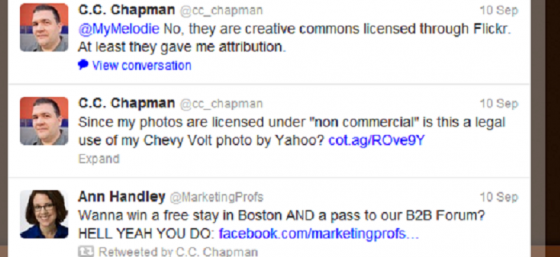
Portion of C.C. Chapman’s Twitter feed – September 10, 2012

I saw the following tweet the other day by author C.C. Chapman: “Since my photos are licensed under “non-commercial” is this a legal use of my Chevy Volt photo by Yahoo?” The question was followed by a link to an article on Yahoo Auto about GM’s report regarding whether Chevy Volts are being sold at a loss. The photo accompanying the article is C.C. Chapman’s photo of a Chevy Volt that he published on Flickr with a Creative Commons license.

This license requires anyone who uses the image to give C.C. Chapman the attribution, only use it for non-commercial use, and not alter the photo in any way. If the image appeared on Chevrolet’s blog, there would be a strong argument that Chevy uses its blog as a marketing tactic to get people to buy its vehicles; therefore every image on the blog is being used for a commercial use. In that case, the use of the image would have violated the license and C.C. Chapman’s copyright.

However, Yahoo published the article. Yahoo isn’t trying to sell cars. It makes money by selling ads and it may charge advertisers based on the number of hits a page gets. C.C. Chapman could make an argument that Yahoo’s use of his photo had a commercial goal; but Yahoo could fire back that it was reporting the news so its use of C.C. Chapman’s photo was protected by fair use. Yahoo could show that it has a history of news reporting and that its articles are accepted as news, not a marketing ploy.

But let’s say this photo appeared on a commercial website in violation of the Creative Commons license. That’s copyright infringement. What could C.C. Chapman do about it?

  1. Do nothing and be happy about the exposure.
  2. Get the photo removed by sending a DMCA takedown notice.
  3. Send the company a cease and desist letter.
  4. Send a bill with a licensing agreement and a letter that says the publisher has committed himself to paying a licensing fee since he already used the photo.
  5. Sue for copyright infringement.

A lot of people would be happy about the exposure and may opt to do nothing. The downside of doing this is someone else could use your work and make a valid argument that your inaction set a precedent that others could use their work for commercial purposes. You may want to send a letter that offers to license the photo in exchange for the exposure and states if the company doesn’t license it then they have to remove it. That way, you will still get your exposure but you still exert your copyright rights in your work.

If you have questions about how to protect your intellectual property rights, contact an intellectual property attorney (like me) in your community.

Feel free to connect with me via Twitter, Facebook, and LinkedIn, or you can email me.
Please visit my homepage for more information about Carter Law Firm.

Lights Camera Lawsuit

There’s always a need for quality legal information for photographers. That’s why I created an online course called Lights Camera Lawsuit: The Legal Side of Professional Photography to address photographers’ most important questions. I want you to feel secure in your business, confident in the way you operate day-to-day, knowing that you’ve set yourself up to get paid what your worth without incident.

At $497, the course contains nearly six hours of legal information you can immediately apply to your business. That’s less than what I charge for two hours of legal work for clients!  

Please subscribe for more information and to make sure you don’t miss out on any special offers or discounts.

Police Arrest Would-Be Prankster for Conspiracy

Jumping Jacks by Flabber DeGasky

Jumping Jacks by Flabber DeGasky

I recently read a news story out of Buffalo, NY about a 17 year-old being charged for conspiracy, criminal nuisance, and disorderly conduct for posting an event on Facebook that invited people to assemble at the Millennium Hotel in Cheektowaga, NY. The reporter called the planned event a “flash mob,” but given that the article said that organizer’s “intent was to cause damage and create chaos,” I doubt that this was a plan constituted a real flash mob. It sounds like an invitation to commit a crime such as disorderly conduct or rioting. I could not find the event on Facebook, so I can’t say for certain what the planned activity was.

Either way the lesson is the same: If you plan an event which involves a crime, you’re asking to be charged with conspiracy and solicitation. Even if you only meant to do something fun, you could still be charged. Even if you cancel the event and nothing bad happens, you could still be charged. Let’s look at what it takes to get charged with each crime.

Conspiracy
In Arizona, you need three things to be commit conspiracy:

  1. Two or more people,
  2. A plan between them that involves committing a crime, and
  3. One overt action in furtherance of that crime, even if that act is not a crime.

So if you and your friend planned to kill someone and one of you bought a shovel to bury the body, you could be charged with conspiracy. Likewise, if your plan was more innocent, like planning a pillow fight where the rules say you can hit anyone in the vicinity with your pillow whether they have a pillow or not and you buy a new pillow for the event, that could also be conspiracy.

Solicitation
It’s also very easy to commit solicitation in Arizona. All you have to do is ask or encourage someone to commit a crime. Even if the person declines the invitation, it’s still solicitation. Asking someone to kill your spouse, regardless of their answer, is solicitation. Likewise, inviting people to participate in a prank that involves touching people in any way without their consent might be solicitation to commit assault. Putting up a Facebook event and making it public could be enough for a solicitation charge.

These types of crimes are easy to commit, especially if you don’t realize that what you’re planning to do is illegal. Your ignorance of the law will generally not protect you from the consequences of your actions. It’s because of this that it’s imperative that you contact a flash mob attorney (like me) when you are beginning to plan your event. Even if the illegality of your event is brought to your attention and you cancel it before anything bad happens, you could still face serious criminal charges.

If you want to know more about committing conspiracy and solicitation by planning a flash mob, I made a video about it. You can also view it here.

Feel free to connect with me via Twitter, Google+, Facebook, and LinkedIn, or you can email me.
Please visit my homepage for more information about Carter Law Firm.

Is Your Non-Compete Agreement Enforceable?

Spider-Man vs. Batman by JD Hancock, Non-compete Agreements

Spider-Man vs. Batman by JD Hancock

When you started your job, did you read your employment agreement before you signed it? What about the employee handbook – did you read it or just sign the form that says you read it? There’s a good chance one of those documents contained a non-compete agreement (NCA).

NCAs are a necessary evil, especially in this day when employees are less likely to stay at a company for their entire careers. These are contracts that restrict your ability to work in a similar position for a specified amount of time and geographic area if you leave the company.

When someone’s thinking of leaving their job, they often review their NCA and ask if it’s valid. A lot of companies won’t hire you if it would violate your NCA. If you think your NCA is invalid, you can go to court and ask a judge to invalidate it.

The court will have a hearing and weigh your interests against your employer’s. On one hand your employer doesn’t want to train someone and give them access to company information to lose them to their direct competition.  On the other hand, you have a right to choose where you work and you shouldn’t become unemployable because of a NCA.

The validity of a NCA is governed by state laws and decisions from previous court cases. There was a great article in the September edition of Arizona Attorney Magazine by David Bray and David Ferrucci about the enforceability of NCAs. Here are some of the highlights.

Courts generally want NCAs to have clear and reasonable provisions. If your NCA can interpreted in two ways – one that narrow and enforceable one that is overly broad and unenforceable and in the ex-employee’s favor – the court will usually rule in that it’s too broad and thus unenforceable. The court will look at whether you negotiated your NCA. Many new hires are given a nonnegotiable NCA as part of their employee handbook and they can either accept it as written or work somewhere else. If the NCA was negotiated, the court will be more likely to try to determine the parties’ intent when they wrote the contract.

There’s also something called the blue-pencil rule in Arizona. This allows a court to excise “grammatically severable” and unreasonable provisions from a contract but keep the reasonable provisions. This keeps the whole contract from being invalid because of one invalid provision.

You can also have step-down provisions in the contract.  An example of this would be, “This non-compete agreement will be in place for 12 months after the employee leaves the company. If a court finds this duration to be invalid, then the duration will be 9 months. If a court finds this duration to be invalid, then the duration will be 6 months.”

A valid step-down provision will only have 2 or 3 choices and be written in good faith. A 2006 Arizona case said that good faith step-down provisions must be:

  1. Definite,
  2. Consistent with the underlying provision,
  3. Easily severable from unreasonable provisions,
  4. Have a narrow duration range, and
  5. Have a reasonable geographic scope.

A valid NCA might result in you not being able to work for a direct competitor or in the physical vicinity of your previous employment, but your skills are likely transferable to other jobs or you can do the same job if you’re willing to do it far enough away from your previous employer.

Read your employment contract carefully. If you’re an employee, get a copy of it before your first day on the job so you can review it and possibly have a business lawyer review it. If you’re an employer, hire a lawyer to write your NCA for you so a court will be less likely to rule that it’s overly broad or otherwise invalid.

One word of caution: In contract cases, Arizona is a “loser pays” state. If you go to court to dispute a NCA and you lose, you’ll be paying for your attorney and the other side’s attorney.

Feel free to connect with me via Twitter, Google+, Facebook, and LinkedIn, or you can email me.
Please visit my homepage for more information about Carter Law Firm.

I’m an ABA Legal Rebel!

Photo by Don McPhee Photography

I’m excited to share the news that I’ve been named a 2012 American Bar Association Legal Rebel! The ABA acknowledges 10 members of the legal community each year for being innovative leaders. I am humbled and honored to be added to this illustrious group.

Photo by Don McPhee Photography

I learned about the Legal Rebels when I was in law school at Arizona State University. Every year they invite a panel of Legal Rebels to the school to talk to students about non-traditional career paths. I’m so grateful they hold this event for people like me who need role models who embody the idea that there’s more than one way to be a successful lawyer. I really admire people like Stephanie Kimbro, Niki Black, and Jeffrey Hughes who created some of the roads less traveled in the legal profession.

I had a wonderful conversation with Legal Rebel Mark Britton at the ABA TechShow this year. I met him the year before when he visited my law school when I was a 3L. In one year, I had gone from sitting in the audience listening to him speak to sharing the stage with him at LexThink.1. At the end of the event he was very encouraging of me and my firm and said I was “doing everything right” with my career.

The ABA selected me to be a Legal Rebel for my work in flash mob law. Even though I’ve been a lawyer for less than a year, I’ve examined the legal issues surrounding flash mobs since 2009 when I participated in my first flash mob – the No Pants Light Rail Ride. A group of us from that event decided we wanted to keep doing these events so we co-founded Improv AZ. Before  every event, I think through the criminal, First Amendment, tort, property, and intellectual property issues and try to ensure that we aren’t setting ourselves or our participants up to get arrested or sued.

Photo by Don McPhee Photography

I’m also an advocate for the real flash mob community. I try to correct the media when they call group criminal activities or any protest or demonstration organized through social media a “flash mob.” I want to maintain our reputation for organizing surprise events that entertain an unsuspecting audience.

I never would have pursued flash mob law without the support of some very special people.  I especially want to thank Ari Kaplan who encouraged me to pursue this niche, my fellow Improv AZ co-founders, and my family and friends who encouraged me to follow my dream of being a flash mob lawyer. Thank you again to the ABA for bestowing this honor upon me and for my awesome Legal Rebel Converse sneakers!

Feel free to connect with me via Twitter, Google+, Facebook, and LinkedIn, or you can email me.
Please visit my homepage for more information about Carter Law Firm.

Employers Can’t Control Personal SM Accounts

i love my job by peretzpup

i love my job by peretzpup

Last week a friend of mine asked about if employers can require employees to do anything with their social media accounts. Apparently, his friend’s employer asked the employees to change the cover photos and avatars on their Facebook pages to some type of advertising for the company.

If a company wants to be involved in social media, they need to create their own accounts on Facebook, Twitter, and any other site where they want to have a presence. They should also have crystal clear contracts with the employees and/or businesses who manage these accounts that state how they should be used, who will own the intellectual property on the sites, and who will own the accounts and followers if the employee leaves or changes positions or if the company hires another company to manage their social media.

Back to employers telling employees what to do on their personal accounts – your personal Facebook account is your personal property. Your employer can prohibit you from being on your personal accounts during work hours or work computers and they can discipline you for violating your employment contract on it (as long as it doesn’t violate the NLRA). But to require you to promote the company on your personal page? That would be a big “Oh hell no.”

I checked out Facebook’s terms of service and they clearly state you must use Facebook Apps for all promotions and that you will not use “your personal timeline for your own commercial gain (such as selling your status update to an advertiser).” If your employment is contingent on promoting the business on your personal account, I see a valid argument that you essentially sold your part of your timeline to your employer.

On the other hand, companies want their employees to be happy in general and want them to support the product. I see no problem in companies making images available if employees wanted to voluntarily change their profile photos. I think it would be awesome if the company allowed employees to take pictures of themselves with a company mural or sign to use in social media if they were so inclined. This would have to be completely voluntary with no consequences, positive or negative, based on employee participation.

I’m a big proponent of employers leaving employees alone when it comes to their personal time and social media accounts as long as the employees aren’t violating company policies. If you think your employer is asking you to do something questionable with your social media accounts, check the website’s terms of service and consult a social media attorney (like me) in your community.

Feel free to connect with me via Twitter, Google+, Facebook, and LinkedIn, or you can email me.
Please visit my homepage for more information about Carter Law Firm.