Register Your Copyrights

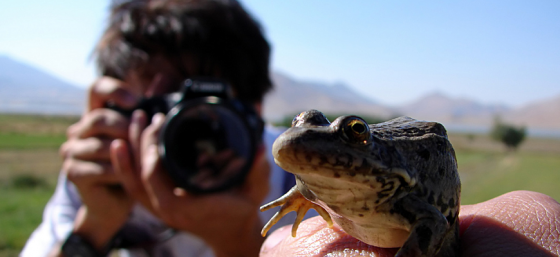
Poor Frog & Macrograpy by Hamed Saber Ruth Carter

Poor Frog & Macrograpy by Hamed Saber

I frequently get questions from people claiming that someone copied a photograph that they own and republished it without their permission. They want to know what their options are for financial recourse. I start by asking them two questions.

  1. When did you take the photograph?
  2. Did you register your copyright?

Most of the time the photograph in question was taken years ago and the photographer didn’t register their copyright.  The majority of artists know that they get exclusive copyright rights the second they create their work in some tangible form, but most of them don’t know that they have to register their work with the U.S. Copyright Office to maximize their protection and options for recourse when someone steals or illegally uses their work.

By creating an original literary, visual, or audiovisual work, you get the exclusive rights to copy, distribute, display, perform, and make derivative works of the original work. When and whether you register your copyright determines how much you might collect if someone violates your rights.

The Copyright Act says you must register your work within 3 months of publication or 1 month of learning of the infringement (whichever happens first!) to be eligible for statutory damages and attorneys’ fees. Statutory damages is money the court can require the infringer to pay you regardless of how much money you lost because of the infringement. If the court decides that the infringer knowingly and willfully stole your work, they can order the infringer to pay you up to $150,000 per violation plus the cost of your attorney!

If you don’t register your copyright within 3 months of publication or 1 month of learning of the infringement, you can only collect your actual damages. This is the amount of money you lost because of the infringement and/or what the infringer earned by copying your work. There are times when your actual damages is $0 because you didn’t lose any money and the infringer didn’t make any money due to the infringement. If you had registered your work within the time frame stated in the Copyright Act, you would have been eligible for statutory damages and attorneys’ fees regardless of our actual damages.

It’s frustrating when I have to tell clients and friends that their options for financial compensation are few or non-existent, because it’s a preventable problem. You can register a copyright electronically online for as little as $35. You can register multiple photographs with one registration application and fee. If you are a professional photographer, you can register each photo shoot with one copyright. Whenever you finish the final product from a shoot, which I suspect is within 3 months of the shoot, take a few minutes to register your work with the U.S. Copyright Office. You can even pass the cost of registration onto your clients by raising your fees $35.

Registering a copyright is fast and easy, and you can do it yourself if you don’t want to a pay a lawyer to do it for you. If doing it by yourself the first time scares you, hire a lawyer to walk you through the process. It doesn’t take much time or money to maximize your protection , so do it.

Feel free to connect with me via Twitter, Google+, Facebook, and LinkedIn.
Please visit my homepage for more information about Carter Law Firm.

What’s Up with the Disclaimers on Facebook?

Avisados by Daniel Lobos, Ruth Carter

Avisados by Daniel Lobos

I’ve had multiple people ask for my take on the following disclaimer that lots of people are posting on their Facebook timelines:

Warning: Any person and/or institution and/or Agent and/or Agency of any governmental structure including but not limited to the United States Federal Government also using or monitoring/using this website or any of its associated websites, you do NOT have my permission to utilize any of my profile information nor any of the content contained herein including, but not limited to my photographs, and/or the comments made about my photographs or any other “art” related posts on my profile. You are hereby notified that you are strictly prohibited from disclosing, copying, distributing, disseminating, or taking any other action against me with regard to this profile and the contents herein. The foregoing prohibitions also apply to your employee(s), agent(s), student(s) or any personnel under your direction or control. The contents of this profile are private and legally privileged and confidential information, and the violation of my personal privacy is punishable by law.

UCC 1-103 1-308 ALL RIGHTS RESERVED WITHOUT PREJUDICE

Apparently people think that rules regarding others’ use of their information and intellectual property changed when Facebook became publicly traded and that posting this disclaimer will prevent others from using their photos and other information contained in their profiles. I hate to burst your bubble, but it doesn’t.

When you signed up for Facebook, you agreed to the terms of the site. The fact that Facebook is now publicly traded doesn’t change anything related to how Facebook can use your information that you willingly posted to your profile.

The current Facebook terms state that you gave Facebook a “non-exclusive, transferable, sub-licensable, royalty-free, worldwide license to use any [intellectual property] content that you post on or in connection with Facebook.” This license ends when you delete the information from your profile. So if you don’t want Facebook to use any of your information or photographs, delete them.

Posting this disclaimer will have no effect. By using Facebook, you continue to agree to abide by the terms of the site. If you read Facebook’s terms and conditions, you will notice that there’s no provision that says you can change the terms. Your options are to accept the terms and keep using the site or to delete everything on your profile and stop using Facebook. You can’t manipulate the terms to get what you want this time.

If you want more information about this issue, check out the Snopes page on this topic.

Feel free to connect with me via Twitter, Google+, Facebook, and LinkedIn.
Please visit my homepage for more information about Carter Law Firm.

Fan Fiction, Copyright Law, and Fair Use

Phoenix Comicon 2012 Badge Ruth Carter

My 2012 Phoenix Comicon Badge - Artwork by Marty Freetage and Bill Farmer Color

I spoke at Phoenix Comicon last week on fair use and fan fiction. I had a great group of people in my audience with who had ideas of turning novels into graphic novels and who wanted to know more about the legalities of things like the Phoenix Comicon badges. This year’s badge featured a parody of Angry Birds and The Avengers.

Speaking at Phoenix Comicon 2012, Ruth Carter photo by Devon Christopher Adams

Speaking at Phoenix Comicon 2012, photo by Devon Christopher Adams

Fair use is a defense against claims of copyright infringement. What generally occurs in these situations is you use someone else’s work in a project, the original copyright owner sues you for copyright infringement, and you respond with an argument that you used the copyright owner’s work but that your use was transformative enough to qualify for protection under the fair use doctrine. The court considers four factors to determine if your use of another’s work is protected by fair use.

  1. Purpose and character of your use of another’s work
  2. Nature of the copyrighted work
  3. Amount and substantiality of the copyrighted work used
  4. Effect on the market

These cases are evaluated on an individual basis. There’s no mathematical equation to determine if you’re protected by fair use. The main factor the court considers is whether your work becomes a substitute for the other person’s work. Parodies are generally transformative enough to qualify for fair use. Let’s look at the fair use factors in regards to the Angry Birds/Avengers badge.

  1. Purpose and character: Phoenix Comicon is a commercial venture, but attendees are paying to attend the con, not specifically to buy the art on the badge.
  2. Nature of the copyrighted work: Both Angry Birds and The Avengers have been previously published. One is a game, the other is a movie. The original copyright owner is generally favored if the work was not previously published.
  3. Amount and substantiality used: The looks of the birds and the Avengers were copied. The looks of both were required for the audience to understand the parody.
  4. Effect on the market: It’s unlikely that someone will seek out Angry Bird art or Avenger art and accept this as a suitable substitute. No one will use this picture as a substitute for the video game or the movie.

Was this badge protected by fair use? Probably, but I’m not a judge and it’s not my call to make.

When it comes to fan fiction, an artist isn’t going to get in trouble if the copyright owner doesn’t know about your work or if they don’t mind that their fans create their own work. If you’re really worried about getting in trouble, you can always ask the copyright owner for permission or a license to use their work.

Fan fiction and fair use are fact specific issues. When in doubt, consult an attorney.

Feel free to connect with me via Twitter, Google+, Facebook, and LinkedIn.
Please visit my homepage for more information about Carter Law Firm.
Creative Commons Images For Your Blog

Question Mark by Ryan

I talk about blogging a lot, both about general blogging information and the legal side of blogging. One of the things I always talk about is the images. Every blog post needs at least one picture. It makes the post more interesting and it can help you portray your subject matter or the emotional impact of your message.

I am not a photographer, so I have to rely on other sources for my photos. If you don’t have a photo that you yourself have taken to use with your post, you can find quality images on Creative Commons. Creative Commons is a license that photographers put on their images that allow you to use them. The particular license tells you how you’re allowed to use it and what credit you have to give to the image owner.

Attribution only – You only have to give credit to the image owner. You can modify the image and use it for   commercial purposes

Attribution-ShareAlike – You may modify the original work and use it for commercial purposes, but you must allow others to use your work in the same way. You must give an attribution to the original image owner.

Attribution-NoDerivs – You may use the image for commercial purposes but you can’t alter the image in any way. You must give credit to the image owner.

Attribution-NonCommercial – You may modify the original image but you may not use it for commercial purposes. You must give an attribution to the image owner.

Attribution-NonCommercial-ShareAlike – You can modify the image but you must allow anyone to use what you create. You can’t use it for commercial purposes and you must give credit to the image owner.

Attribution-NonCommercial-NoDerivs – You may only use the image, as is, for non-commercial purposes. You may not modify the image, and you must give an attribution to the image owner.

When I look for photos for my blogs, I always pick photos that come with an Attribution only or Attribution-ShareAlike license, and I encourage everyone to do the same. When I add a photo to my blog, I put the name of the image and the attribution to the image owner in the caption, and make the caption visible on the post. In the image description, I include a link back to the original image, which is usually on Flickr.

I use these license because they are the most user-friendly. If you need to crop a photo, these licenses will allow you to do that. I also recommend always using photos that you’re allowed to use for commercial purposes.  Even if you don’t make money on your blog from ads or by having you blog connected to a business now, you might in the future. If you start making money via your blog and you have images on your blog that you’re not allowed to use for commercial purposes, you have to go back and remove those images from your site. It’s easier in the long run if you have permission to commercialize all of your images from the start.

If there’s an image you really you want to use on your blog, but it doesn’t come with a Creative Commons license, you can always ask the image owner if you can use it. I have standing agreements with Devon Christopher Adams and Sheila Dee because I ask to use their photos so often.

Phoenix Comicon Preview – Fan Fiction and Copyright Law

Superman vs. Hulk by JD Hancock

I am so excited for Phoenix Comicon, coming up Memorial Day weekend at the Phoenix Convention Center. It’s the 25th anniversary of Star Trek: The Next Generation, and a lot of the cast is going to be there. I’ve been a card-carrying Trekkie for almost 20 years and The Next Generation was the show that started it all for me.

I’m also super excited that I’ve been invited to speak at Phoenix Comicon this year. My talk is on Thursday evening at 7pm in room 127A of the North Building. The organizers gave my talk a really fancy name, “Adapting Licensed Properties to Comics,” but don’t let that confuse or scare you. I’m going to be talking about how copyright law applies to fan art, fan fiction, and slash fiction. We can also get into issues about sci-fi or comic inspired tattoos, and any other copyright topics we have time to cover.

I think fan art and fan fiction is fantastic and should be encouraged because it makes us keep falling in love with our favorite comics and shows over and over again. But if you create your own sci-fi or comic inspired art work or fiction, you should know about the copyright implications that apply to you. I’m going to talk about how fair use works and I’m going to tell a story about how an independent artist was able to create a Wizard of Oz decorative plate and copyright it. It can be done – if you know how to do it right.

My talk has the benefit of being right before the Semi-finals of the Phoenix Ultimate Geek Smackdown (PUGS). Come see me on Thursday at 7pm and stay for PUGS in room 121 at 8pm!

Here’s the recap:
Who: Me
What: Speaking at Phoenix Comicon – “Adapting Licensed Properties to Comics” – aka Copyright and Fan Fiction
Where: Phoenix Convention Center, North Building, room 127A
When: Thursday, May 24th – 7pm

The Risk Of Not Registering Your Trademark

Kitty Your Ad Here by Shannon Kringen

If you’re a small business owner you probably created an LLC. You may have even registered your trade name with the Secretary of State. A lot of small businesses don’t see the value in registering their trademark with the United States Patent and Trademark Office (USPTO). If you register your mark with the USPTO, you can prevent anyone in the country from using your mark in their business in a confusingly similar way.

If you’re a local business, you may question the value in being able to claim your trademark in all 50 states. The question you should ask is, “What do I risk if I don’t?” Let me tell you a story.

The Finer Things in Life by comedy_nose

The first Burger King restaurant was little place in Mattoon, Illinois. It looks like a mom and pop restaurant. They didn’t register their trademark with the USPTO. After this Burger King opened, the Burger King franchise as we know it was created, and they registered the Burger King trademark with the USPTO. The original Burger King was allowed to continue doing business, but it’s limited to its existing market, which is a 20-mile radius around the restaurant. Burger King franchises can be everywhere else in the United States and the original Burger King can’t expand beyond the 20-mile boundary.

If you have a small business and you have plans to expand, you want to be the first to register your trademark, because if you don’t, you might find yourself being boxed into a limited area if your competition registers the mark. Even if you don’t have plans to expand much, you want the ability to take advantage of a golden growth opportunity if it comes along. If your competition registers their mark first, you might find yourself in a situation where you have to change your name and rebrand yourself to be able to expand your business.

New businesses put hundreds, and sometimes thousands of dollars in branding themselves. Ideally, you should decide what you want your trademark to be, check the USPTO to make sure no one is using your desired trademark, and consult a trademark attorney about registering the mark for your business. You may not be growing by leaps and bounds today, but you don’t want to find yourself in a situation where that’s not possible for you or only an option if you spend hundreds of hours and thousands of dollars rebranding yourself.

When Can Someone Post Photos Of You Online?

My Camera by Paul Reynolds

I’ve had a few people ask me about the legalities of posting pictures of other people online. I thought I’d tackle the most common issue with photographs – whether you have a reasonable expectation of privacy. I’m not going to get into commercializing a person’s image or misrepresenting a person. I’m only addressing whether someone can post a picture that they took of you on their Facebook page, blog, Flickr, etc.

No Pants Light Rail Ride 2012 by Devon Christopher Adams

Pictures of You in Public
You have no expectation of privacy in anything you do in public. This includes where you go and what you do while you’re there. For example, I just got an adorable basset hound named Rosie. We take walks every day. I have no expectation of privacy regarding where we walk, what I’m wearing when I walk her, or how I react when she pulls on the leash. That’s all in plain view for everyone to see. Anyone can take a picture of us and post it online, preferably with a caption that says, “Sassy lady and her awesome dog,” and there’s nothing I can do about it (as long as they’re not misrepresenting me or commercializing my image without my consent).

If you’re in a public place and someone snaps a picture of you while you’re falling down drunk, getting arrested, picking your nose, scowling at a crying baby, or not wearing pants, there’s probably nothing you can do if that picture shows up online somewhere.

The exception to this rule is you have an expectation of privacy in places like public bathroom stalls, changing rooms, tanning salons, and doctor’s offices that may require you to be partially or completely undressed.

Pictures of You in Private Venues
When pictures are taken of you at a private event or in someone’s private home, you have to ask whether you had an expectation of privacy in each particular situation. If you attend a party where there are no rules regarding photos and everyone has their cameras out, you have no expectation of privacy if someone takes a photo of you and puts it in their online album.

Some events come with ground rules regarding photos that could create an expectation of privacy. I had a friend in college who had a Decorate Your Nipples theme party where everyone had to decorate their chest. Some people put decorations on their shirts and some people opted to decorate their skin. The rule for that party was that no cameras were allowed except during the designated picture time. At picture time, all the photos were limited to one room. If you didn’t want any photographic documentation of your being at that party, you had to go to the no-camera room.

There may be activities where there are no specified rules about photographs, but where the nature of the event or activity gives you an expectation of privacy. For example, if you and your partner make a sex tape or take intimate pictures of each other, there’s an inherent expectation that no one beside you two would see them. If you break up, your partner can’t post the pictures online and protect themselves by saying that you never agreed to keep them private.

When it comes to the question, “Can I post pictures of other people online?,” the answer is always, “It depends.” My general rule of thumb is “Don’t do anything in public that you wouldn’t put on the front page of the paper.” When it comes to photographs, the same rule generally applies because you might end up in a situation where you had an expectation of privacy but someone posted a picture of you online that they shouldn’t have. You might have a case against the jerk who posed it, but you still have to deal with the possibility that a lot of people saw a photo of you that they should have never seen.

If you want more information about the legal rules regarding social media, please check out The Legal Side of Blogging: How Not to get Sued, Fired, Arrested, or Killed. I also maintain a mailing list where I share my thoughts about being a lawyer/entrepreneur, updates about projects I’m working on, upcoming speaking engagements, and I may provide information about products, services, and discounts. Please add yourself if you’re interested. You can also contact me directly or connect with me on Twitter, Facebook, YouTube, or LinkedIn.

Ruth Carter’s Speaking Schedule – May 2012

Ignite Phoenix #5 by Sheila Dee

Ignite Phoenix #5 by Sheila Dee

May is going to be an exciting month for me because I have four speaking engagements in Phoenix! I’m really excited to get out and talk about intellectual property and social media law. I like to keep my talks casual, interactive, and provide useful information to the audience.  I hope you’ll come out and have fun with me. Here’s where you can find me . . .

Trademark Basics
Wednesday, May 9, 2012 – 6pm
Midweek Mind Tweak – Co+Hoots
This is an interactive discussion about what a trademark is, the strength of attendees’ trademarks, and the benefit of registering your trademark with the U.S. Patent and Trademark Office.

Why You Need a Social Media Policy
Wednesday, May 16, 2012 – 5pm
Midweek Mind Tweak – Co+Hoots
Every company needs a social media policy for their employees, but if you create one that is too broad, you might have to pay over $10,000 for violating the National Labor Relations Act. It’s a problem that is easy to fix, if you know what the law is.

The Legalities of Blogging
Wednesday, May 23, 2012 – 12pm
GP Brownbag – Gangplank Chandler
A spoke a few weeks ago at Gangplank Academy about the legal side of blogging, and they asked me back to present a condensed version as a brownbag discussion. I’ll be presenting the 8 questions you should ask yourself before you publish a blog post.

Adapting Licensed Properties to Comics
Thursday, May 24, 2012 – 7pm
Phoenix Comicon – Phoenix Convention Center
I’m so excited to speak at Phoenix Comicon. The thought fills my little geek heart with joy. I’m going to be talking with sci-fi and comic book fans about copyright issues related to creating fan fiction, fan art, and slash fiction. It’s going to be so much fun!

I hope I get to see you at one or all of my talks!

Call Your Representative to Oppose CISPA

Laptop Stickers by YayAdrian

The U.S. House of Representatives could be voting this Friday on the Cyber Intelligence Sharing and Protection Act (CISPA). It’s important that you call your representatives today and let them know that you oppose CISPA, and they should too.

CISPA is the government’s latest attempt to invade our privacy. They say the law’s purpose is to prevent and counteract cyberattacks. This law will let private companies and the government ignore every privacy law and share your personal information. All they need to have is a “good faith” belief that they’re doing it for cybersecurity purposes, which sounds like they’re allowed to manipulate the way they describe a situation  to manufacture a good faith belief.

The proposed law has had a few amendments aimed at protecting our civil liberties, but I’m not convinced. The amendments will still let agencies like the National Security Agency have “unfettered access to information about Americans’ internet activities and allow those agencies to use that information for virtually any purpose.”

CISPA - The Solution is the Problem by DonkeyHotey

The Electronic Frontier Foundation has a great resource that gives you your representative’s phone number and a script you can use when you call them to urge them to vote against CISPA. I called my representative, Ben Quayle, and I was shocked to learn that he’s a co-sponsor of the bill. I told his office that he should stay out of my computer (and my vagina for that matter).

Here’s your to-do list:

The government will always try to overstep the limits and invade our privacy. It’s our job, as the people who hired them, to keep them in check and tell them what to do.

BULLY – Go See It!

Candlelight Vigil by B. W. TownsendI had the pleasure of attending an advanced screening of Bully last week. I rarely go to the movies, so if you see me in a theatre, you know I’m really motivated to be there. If you haven’t seen it, go see it – and take your kids! It’s only showing for a short time, so get on it.

Bullying is a life-or-death problem. Children are killing themselves to escape bullying and cyberbullying. If you don’t believe me, asked Kirk and Laura. Their 11 year-old son Ty killed himself because he was bullied so badly at school. They created an organization in his memory called Stand For The Silent to empower young people to stand up to bullies.

Bully was originally rated R because of the language. It was only after the movie that I realized that the language that would have made it rated R was coming out of the mouths of the kids! And this is a documentary – it wasn’t scripted swearing. It’s ironic that the MPAA initially decided that children shouldn’t see the movie because middle schoolers were voluntarily swearing in the film.

This movie will break your heart. It follows several bullied kids at different schools. It was sad to see their dejected faces that showed they’ve resigned themselves to being the bullied child with no hope that their situation could get better. One child’s story was particularly disturbing. He had almost no expression on his face. He had no friends and he was hit, strangled, and harassed every day on the bus. Even when he was asked, he never mentioned how bad things were to his family. His parents had no idea what their child experienced until the producers showed them the footage. They took their concerns to the school to only have their concerns minimized and dismissed. I hope the school has changed now that thousands of people have seen how ineffective they were.

I was really impressed by one of the bullied kids, Kelby. She’s a lesbian and her family was rejected by their small community when she came out. Her father offered to move the family so she could live in a more accepting community and she declined. She decided to stay because she said if she moved, the bullies would win. By the end of the film, she dropped out of school because it wasn’t worth it to her to be there anymore. I admire her efforts to fight the good fight. People like Kelby are the reason why the law needs to allow kids to drop out of school at 16 and get a GED instead. If school is not a safe place, then students shouldn’t be forced to be there.

When the movie ended, I was left asking myself, “What’s the answer?” Schools need to do what is necessary to stop bullying and not dismiss, ignore, or blame the victims. Every school should be mandated to have an anti-bullying program. Educators should be required to educate and protect their students, and if they can’t do one of those jobs, they need to find a new profession. Every person at a school (teachers, administrators, and students) should foster an environment of acceptance. If a school is not protecting its students from bullies, the school should be publically called out on sites like Great Schools and be held accountable for their ineffectiveness.